
مشخصات کتاب
-
BillEvjen
-
2009
-
انگلیسی
-
5374
-
569
-
1
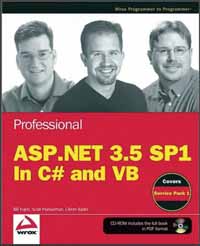
Professional ASP.NET 3.5 SP1 Edition In C# and VB
Introduction xxxvii
Chapter 1: Application and Page Frameworks 1
Application Location Options 1
Built-In Web Server 2
IIS 3
FTP 3
Web Site Requiring FrontPage Extensions 5
The ASP.NET Page Structure Options 5
Inline Coding 7
Code-Behind Model 9
ASP.NET 3.5 Page Directives 11
@Page 12
@Master 15
@Control 17
@Import 18
@Implements 20
@Register 20
@Assembly 21
@PreviousPageType 21
@MasterType 21
@OutputCache 22
@Reference 22
ASP.NET Page Events 23
Dealing with PostBacks 24
Cross-Page Posting 25
ASP.NET Application Folders 32
\App_Code Folder 32
\App_Data Folder 37
\App_Themes Folder 37
\App_GlobalResources Folder 38
\App_LocalResources 38
\App_WebReferences 38
\App_Browsers 38
Compilation 39
Build Providers 43
Using the Built-in Build Providers 44
Using Your Own Build Providers 45
Global.asax 50
Working with Classes Through VS2008 53
Summary 59
Chapter 2: ASP.NET Server Controls and Client-Side Scripts 61
ASP.NET Server Controls 61
Types of Server Controls 62
Building with Server Controls 63
Working with Server Control Events 65
Applying Styles to Server Controls 68
Examining the Controls’ Common Properties 68
Changing Styles Using Cascading Style Sheets 70
HTML Server Controls 73
Looking at the HtmlControl Base Class 76
Looking at the HtmlContainerControl Class 77
Looking at All the HTML Classes 78
Using the HtmlGenericControl Class 79
Manipulating Pages and Server Controls with JavaScript 80
Using Page.ClientScript.RegisterClientScriptBlock 82
Using Page.ClientScript.RegisterStartupScript 83
Using Page.ClientScript.RegisterClientScriptInclude 85
Client-Side Callback 86
Comparing a Typical Postback to a Callback 86
Using the Callback Feature—A Simple Approach 87
Using the Callback Feature with a Single Parameter 92
Using the Callback Feature—A More Complex Example 95
Summary 101
Chapter 3: ASP.NET Web Server Controls 103
An Overview of Web Server Controls 103
The Label Server Control 104
The Literal Server Control 106
The TextBox Server Control 107
Using the Focus() Method 108
Using AutoPostBack 108
Using AutoCompleteType 110
The Button Server Control 111
The CausesValidation Property 111
The CommandName Property 111
Buttons That Work with Client-Side JavaScript 112
The LinkButton Server Control 114
The ImageButton Server Control 115
The HyperLink Server Control 116
The DropDownList Server Control 117
Visually Removing Items from a Collection 119
The ListBox Server Control 121
Allowing Users to Select Multiple Items 121
An Example of Using the ListBox Control 122
Adding Items to a Collection 124
The CheckBox Server Control 124
How to Determine Whether Check Boxes Are Checked 126
Assigning a Value to a Check Box 126
Aligning Text Around the Check Box 126
The CheckBoxList Server Control 127
The RadioButton Server Control 129
The RadioButtonList Server Control 131
Image Server Control 132
Table Server Control 134
The Calendar Server Control 136
Making a Date Selection from the Calendar Control 137
Choosing a Date Format to Output from the Calendar 138
Making Day, Week, or Month Selections 139
Working with Date Ranges 139
Modifying the Style and Behavior of Your Calendar 141
AdRotator Server Control 145
The Xml Server Control 146
Panel Server Control 147
The PlaceHolder Server Control 150
BulletedList Server Control 150
HiddenField Server Control 155
FileUpload Server Control 156
Uploading Files Using the FileUpload Control 157
Giving ASP.NET Proper Permissions to Upload Files 160
Understanding File Size Limitations 161
Uploading Multiple Files from the Same Page 162
Placing the Uploaded File into a Stream Object 164
Moving File Contents from a Stream Object to a Byte Array 165
MultiView and View Server Controls 166
Wizard Server Control 170
Customizing the Side Navigation 171
Examining the AllowReturn Attribute 172
Working with the StepType Attribute 172
Adding a Header to the Wizard Control 173
Working with the Wizard’s Navigation System 173
Utilizing Wizard Control Events 174
Using the Wizard Control to Show Form Elements 176
ImageMap Server Control 180
Summary 182
Chapter 4: Validation Server Controls 185
Understanding Validation 185
Client-Side versus Server-Side Validation 186
ASP.NET Validation Server Controls 187
Validation Causes 188
The RequiredFieldValidator Server Control 189
The CompareValidator Server Control 194
The RangeValidator Server Control 198
The RegularExpressionValidator Server Control 201
The CustomValidator Server Control 202
The ValidationSummary Server Control 208
Turning Off Client-Side Validation 211
Using Images and Sounds for Error Notifications 212
Working with Validation Groups 213
Summary 217
Chapter 5: Working with Master Pages 219
Why Do You Need Master Pages? 219
The Basics of Master Pages 221
Coding aMaster Page 223
Coding a Content Page 225
Mixing Page Types and Languages 229
Specifying Which Master Page to Use 231
Working with the Page Title 232
Working with Controls and Properties from the Master Page 233
Specifying Default Content in theMaster Page 240
Programmatically Assigning the Master Page 241
NestingMaster Pages 243
Container-Specific Master Pages 247
Event Ordering 248
Caching with Master Pages 249
ASP.NET AJAX and Master Pages 249
Summary 252
Chapter 6: Themes and Skins 253
Using ASP.NET Themes 253
Applying a Theme to a Single ASP.NET Page 253
Applying a Theme to an Entire Application 255
Removing Themes from Server Controls 256
Removing Themes from Web Pages 257
Understanding Themes When Using Master Pages 257
Understanding the StyleSheetTheme Attribute 258
Creating Your Own Themes 258
Creating the Proper Folder Structure 258
Creating a Skin 259
Including CSS Files in Your Themes 261
Having Your Themes Include Images 264
DefiningMultiple Skin Options 267
Programmatically Working with Themes 269
Assigning the Page’s Theme Programmatically 269
Assigning a Control’s SkinID Programmatically 270
Themes, Skins, and Custom Controls 270
Summary 274
Chapter 7: Data Binding in ASP.NET 3.5 275
Data Source Controls 275
SqlDataSource Control 277
LINQ Data Source Control 289
AccessDataSource Control 294
XmlDataSource Control 294
ObjectDataSource Control 295
SiteMapDataSource Control 300
Configuring Data Source Control Caching 300
Storing Connection Information 301
Using Bound List Controls with Data Source Controls 304
GridView 304
Editing GridView Row Data 320
Deleting GridView Data 327
DetailsView 330
Inserting, Updating, and Deleting Data Using DetailsView 335
ListView 336
FormView 345
Other Databound Controls 350
DropDownList, ListBox, RadioButtonList, and CheckBoxList 350
TreeView 350
Ad Rotator 351
Menu 351
Inline Data-Binding Syntax 352
Data-Binding Syntax Changes 353
XML Data Binding 353
Expressions and Expression Builders 354
Summary 359
Chapter 8: Data Management with ADO.NET 361
Basic ADO.NET Features 362
Common ADO.NET Tasks 362
Basic ADO.NET Namespaces and Classes 367
Using the Connection Object 368
Using the Command Object 370
Using the DataReader Object 371
Using Data Adapter 373
Using Parameters 376
Understanding DataSet and DataTable 379
Using Oracle as Your Database with ASP.NET 3.5 384
The DataList Server Control 387
Looking at the Available Templates 387
Working with ItemTemplate 388
Working with Other Layout Templates 390
Working with Multiple Columns 392
The ListView Server Control 393
Looking at the Available Templates 394
Using the Templates 394
Creating the Layout Template 396
Creating the ItemTemplate 398
Creating the EditItemTemplate 398
Creating the EmptyItemTemplate 399
Creating the InsertItemTemplate 399
The Results 400
Using Visual Studio for ADO.NET Tasks 402
Creating a Connection to the Data Source 402
Working with a Dataset Designer 404
Using the CustomerOrders DataSet 409
Asynchronous Command Execution 414
Asynchronous Connections 435
Summary 435
Chapter 9: Querying with LINQ 437
LINQ to Objects 437
Traditional Query Methods 437
Replacing Traditional Queries with LINQ 446
Data Grouping 453
Other LINQ Operators 454
LINQ Joins 455
Paging Using LINQ 457
LINQ to XML 458
Joining XML Data 461
LINQ to SQL 462
Insert, Update, and Delete Queries through LINQ 471
Extending LINQ 475
Summary 475
Chapter 10: Working with XML and LINQ to XML 477
The Basics of XML 478
The XML InfoSet 480
XSD–XML Schema Definition 481
Editing XML and XML Schema in Visual Studio 2008 483
XmlReader and XmlWriter 486
Using XDocument Rather Than XmlReader 488
Using Schema with XmlTextReader 489
Validating Against a Schema Using an XDocument 491
Including NameTable Optimization 493
Retrieving .NET CLR Types from XML 495
ReadSubtree and XmlSerialization 497
Creating CLR Objects from XML with LINQ to XML 498
Creating XML with XmlWriter 499
Creating XML with LINQ for XML 502
Improvements for XmlReader and XmlWriter in 2.0 504
XmlDocument and XPathDocument 505
Problems with the DOM 505
XPath, the XPathDocument, and XmlDocument 505
DataSets 510
Persisting DataSets to XML 510
XmlDataDocument 511
The XmlDataSource Control 513
XSLT 517
XslCompiledTransform 518
XSLT Debugging 523
Databases and XML 524
FOR XML AUTO 524
SQL Server 2005 and the XML Data Type 528
Summary 535
Chapter 11: IIS7 537
Modular Architecture of IIS7 537
IIS-WebServer 538
IIS-WebServerManagementTools 541
IIS-FTPPublishingService 542
Extensible Architecture of IIS7 542
IIS7 and ASP.NET Integrated Pipeline 542
Building a Customized Web Server 544
Update Dependencies 545
Installing IIS7 on Windows Vista 545
Installing IIS7 on Windows Server 2008 545
Command-Line Setup Options 546
Unattended Setup Option 548
Upgrade 548
Internet Information Services (IIS)Manager 549
Application Pools 550
Web Sites 554
Hierarchical Configuration 555
Delegation 561
Moving an Application from IIS6 to IIS7 564
Summary 566
Chapter 12: Introduction to the Provider Model 567
Understanding the Provider 568
The Provider Model in ASP.NET 3.5 569
Setting Up Your Provider to Work with Microsoft SQL Server 7.0, 2000, 2005, or 2008 571
Membership Providers 577
Role Providers 581
The Personalization Provider 585
The SiteMap Provider 586
SessionState Providers 588
Web Event Providers 590
Configuration Providers 598
The WebParts Provider 601
Configuring Providers 603
Summary 604
Chapter 13: Extending the Provider Model 605
Providers Are One Tier in a Larger Architecture 605
Modifying Through Attribute-Based Programming 606
Simpler Password Structures Through the SqlMembershipProvider 607
Stronger Password Structures Through the SqlMembershipProvider 610
Examining ProviderBase 611
Building Your Own Providers 613
Creating the CustomProviders Application 613
Constructing the Class Skeleton Required 614
Creating the XML User Data Store 617
Defining the Provider Instance in the web.config File 618
Not Implementing Methods and Properties of the MembershipProvider Class 619
Implementing Methods and Properties of the MembershipProvider Class 620
Using the XmlMembershipProvider for User Login 628
Extending Pre-Existing Providers 629
Limiting Role Capabilities with a New LimitedSqlRoleProvider Provider 630
Using the New LimitedSqlRoleProvider Provider 634
Summary 638
Chapter 14: Site Navigation 639
XML-Based SiteMaps 640
SiteMapPath Server Control 642
The PathSeparator Property 644
The PathDirection Property 646
The ParentLevelsDisplayed Property 646
The ShowToolTips Property 647
The SiteMapPath Control’s Child Elements 648
TreeView Server Control 648
Identifying the TreeView Control’s Built-In Styles 652
Examining the Parts of the TreeView Control 653
Binding the TreeView Control to an XML File 654
Selecting Multiple Options in a TreeView 656
Specifying Custom Icons in the TreeView Control 659
Specifying Lines Used to Connect Nodes 661
Working with the TreeView Control Programmatically 663
Menu Server Control 669
Applying Different Styles to the Menu Control 670
Menu Events 675
Binding the Menu Control to an XML File 676
SiteMap Data Provider 678
ShowStartingNode 678
StartFromCurrentNode 679
StartingNodeOffset 680
StartingNodeUrl 681
SiteMap API 681
URL Mapping 684
Sitemap Localization 685
Structuring the Web.sitemap File for Localization 685
Making Modifications to the Web.config File 686
Creating Assembly Resource (.resx) Files 687
Testing the Results 687
Security Trimming 689
Setting Up Role Management for Administrators 690
Setting Up the Administrators’ Section 691
Enabling Security Trimming 692
Nesting SiteMap Files 694
Summary 696
Chapter 15: Personalization 699
The PersonalizationModel 699
Creating Personalization Properties 700
Adding a Simple Personalization Property 701
Using Personalization Properties 702
Adding a Group of Personalization Properties 706
Using Grouped Personalization Properties 707
Defining Types for Personalization Properties 707
Using Custom Types 708
Providing Default Values 711
Making Personalization Properties Read-Only 711
Anonymous Personalization 711
Enabling Anonymous Identification of the End User 711
Working with Anonymous Identification 714
Anonymous Options for Personalization Properties 715
Warnings about Anonymous User Profile Storage 716
Programmatic Access to Personalization 717
Migrating Anonymous Users 717
Personalizing Profiles 718
Determining Whether to Continue with Automatic Saves 719
Personalization Providers 721
Working with SQL Server Express Edition 721
Working with Microsoft’s SQL Server 7.0/2000/2005/2008 722
Using Multiple Providers 724
Managing Application Profiles 725
Properties of the ProfileManager Class 725
Methods of the ProfileManager Class 726
Building the ProfileManager.aspx Page 726
Examining the Code of ProfileManager.aspx Page 730
Running the ProfileManager.aspx Page 731
Summary 732
Chapter 16: Membership and Role Management 733
Authentication 734
Authorization 734
ASP.NET 3.5 Authentication 734
Setting Up Your Web Site for Membership 734
Adding Users 737
Asking for Credentials 752
Working with Authenticated Users 760
Showing the Number of Users Online 762
Dealing with Passwords 764
ASP.NET 3.5 Authorization 769
Using the LoginView Server Control 769
Setting Up Your Web Site for Role Management 771
Adding and Retrieving Application Roles 775
Deleting Roles 777
Adding Users to Roles 778
Getting All the Users of a Particular Role 779
Getting All the Roles of a Particular User 781
Removing Users from Roles 781
Checking Users in Roles 782
Understanding How Roles Are Cached 783
Using the Web Site Administration Tool 784
Public Methods of theMembership API 784
Public Methods of the Roles API 786
Summary 786
Chapter 17: Portal Frameworks and Web Parts 787
Introducing Web Parts 787
Building Dynamic and Modular Web Sites 789
Introducing the WebPartManager Control 789
Working with Zone Layouts 790
Understanding the WebPartZone Control 794
Allowing the User to Change the Mode of the Page 797
Modifying Zones 808
Working with Classes in the Portal Framework 814
Creating CustomWeb Parts 818
ConnectingWeb Parts 824
Building the Provider Web Part 825
Building the Consumer Web Part 828
Connecting Web Parts on an ASP.NET Page 830
Understanding the Difficulties in Dealing with Master Pages When Connecting Web Parts 833
Summary 834
Chapter 18: HTML and CSS Design with ASP.NET 835
Caveats 836
HTML and CSS Overview 836
Introducing CSS 837
Creating Style Sheets 837
CSS Rules 840
CSS Inheritance 849
Element Layout and Positioning 850
Working with HTML and CSS in Visual Studio 857
ASP.NET 2.0 CSS–Friendly Control Adapters 864
Summary 865
Chapter 19: ASP.NET AJAX 867
Understanding the Need for AJAX 867
Before AJAX 868
AJAX Changes the Story 868
ASP.NET AJAX and Visual Studio 2008 871
Client-Side Technologies 872
Server-Side Technologies 873
Developing with ASP.NET AJAX 874
ASP.NET AJAX Applications 874
Building a Simple ASP.NET Page without AJAX 876
Building a Simple ASP.NET Page with AJAX 878
ASP.NET AJAX’s Server-Side Controls 884
The ScriptManager Control 884
The ScriptManagerProxy Control 887
The Timer Control 888
The UpdatePanel Control 890
The UpdateProgress Control 895
UsingMultiple UpdatePanel Controls 897
Working with Page History 901
Script Combining 907
Summary 912
Chapter 20: ASP.NET AJAX Control Toolkit 913
Downloading and Installing 914
New Visual Studio Templates 915
Adding the New Controls to the VS2008 Toolbox 916
The ASP.NET AJAX Controls 917
ASP.NET AJAX Control Toolkit Extenders 920
AlwaysVisibleControlExtender 920
AnimationExtender 923
AutoCompleteExtender 924
CalendarExtender 928
CollapsiblePanelExtender 929
ConfirmButtonExtender and ModalPopupExtender 931
DragPanelExtender 933
DropDownExtender 935
DropShadowExtender 937
DynamicPopulateExtender 939
FilteredTextBoxExtender 944
HoverMenuExtender 945
ListSearchExtender 946
MaskedEditExtender and MaskedEditValidator 947
MutuallyExclusiveCheckBoxExtender 950
NumericUpDownExtender 952
PagingBulletedListExtender 953
PopupControlExtender 954
ResizableControlExtender 956
RoundedCornersExtender 958
SliderExtender 959
SlideShowExtender 961
TextBoxWatermarkExtender 964
ToggleButtonExtender 965
UpdatePanelAnimationExtender 967
ValidatorCalloutExtender 968
ASP.NET AJAX Control Toolkit Server Controls 969
Accordion Control 969
CascadingDropDown 972
NoBot Control 975
PasswordStrength Control 977
Rating Control 978
TabContainer Control 979
Summary 981
Chapter 21: Security 983
Authentication and Authorization 984
Applying AuthenticationMeasures 984
The <authentication> Node 985
Windows-Based Authentication 986
Forms-Based Authentication 994
Passport Authentication 1004
Authenticating Specific Files and Folders 1004
Programmatic Authorization 1005
Working with User.Identity 1006
Working with User.IsInRole() 1007
Pulling More Information with WindowsIdentity 1008
Identity and Impersonation 1011
Securing Through IIS 1013
IP Address and Domain Name Restrictions 1013
Working with File Extensions 1014
Using the ASP.NET MMC Snap-In 1017
Using the IIS 7.0 Manager 1018
Summary 1019
Chapter 22: State Management 1021
What Are Your Choices? 1022
Understanding the Session Object in ASP.NET 1024
Sessions and the Event Model 1024
Configuring Session State Management 1026
In-Process Session State 1026
Out-of-Process Session State 1034
SQL-Backed Session State 1040
Extending Session State with Other Providers 1042
Cookieless Session State 1044
Choosing the Correct Way to Maintain State 1046
The Application Object 1046
QueryStrings 1047
Cookies 1047
PostBacks and Cross-Page PostBacks 1048
Hidden Fields, ViewState, and ControlState 1050
Using HttpContext.Current.Items for Very Short-Term Storage 1055
Summary 1056
Chapter 23: Caching 1057
Caching 1057
Output Caching 1057
Partial Page (UserControl) Caching 1060
Post-Cache Substitution 1061
HttpCachePolicy and Client-Side Caching 1064
Caching Programmatically 1066
Data Caching Using the Cache Object 1066
Controlling the ASP.NET Cache 1067
Cache Dependencies 1067
Using the SQL Server Cache Dependency 1073
Enabling Databases for SQL Server Cache Invalidation 1074
Enabling Tables for SQL Server Cache Invalidation 1074
Looking at SQL Server 2000 1075
Looking at the Tables That Are Enabled 1076
Disabling a Table for SQL Server Cache Invalidation 1076
Disabling a Database for SQL Server Cache Invalidation 1077
SQL Server 2005 Cache Invalidation 1077
Configuring Your ASP.NET Application 1078
Testing SQL Server Cache Invalidation 1080
Adding More Than One Table to a Page 1082
Attaching SQL Server Cache Dependencies to the Request Object 1082
Attaching SQL Server Cache Dependencies to the Cache Object 1083
Summary 1087
Chapter 24: Debugging and Error Handling 1089
Design-Time Support 1089
Syntax Notifications 1090
Immediate and Command Window 1092
Task List 1092
Tracing 1093
System.Diagnostics.Trace and ASP.NET’s Page.Trace 1094
Page-Level Tracing 1094
Application Tracing 1094
Viewing Trace Data 1095
Tracing from Components 1098
Trace Forwarding 1100
TraceListeners 1100
Diagnostic Switches 1105
Web Events 1106
Debugging 1108
What’s Required 1108
IIS versus ASP.NET Development Server 1109
Starting a Debugging Session 1110
New Tools to Help You with Debugging 1114
Client-side Javascript Debugging 1116
SQL Stored Proc Debugging 1119
Exception and Error Handling 1119
Handling Exceptions on a Page 1120
Handling Application Exceptions 1121
Http Status Codes 1122
Summary 1123
Chapter 25: File I/O and Streams 1125
Working with Drives, Directories, and Files 1126
The DriveInfo Class 1126
The Directory and DirectoryInfo Classes 1129
File and FileInfo 1135
Working with Paths 1140
File and Directory Properties, Attributes, and Access Control Lists 1144
Reading and Writing Files 1151
Streams 1152
Readers and Writers 1156
Compressing Streams 1161
Working with Serial Ports 1166
Network Communications 1167
WebRequest and WebResponse 1167
Sending Mail 1174
Summary 1175
Chapter 26: User and Server Controls 1177
User Controls 1178
Creating User Controls 1178
Interacting with User Controls 1180
Loading User Controls Dynamically 1182
Server Controls 1187
WebControl Project Setup 1188
Control Attributes 1193
Control Rendering 1194
Adding Tag Attributes 1199
Styling HTML 1201
Themes and Skins 1204
Adding Client-Side Features 1205
Detecting and Reacting to Browser Capabilities 1214
Using ViewState 1217
Raising PostBack Events 1221
Handling PostBack Data 1225
Composite Controls 1227
Templated Controls 1230
Creating Control Design-Time Experiences 1237
Summary 1257
Chapter 27: Modules and Handlers 1259
Processing HTTP Requests 1259
IIS 5/6 and ASP.NET 1259
IIS 7 and ASP.NET 1260
ASP.NET Request Processing 1261
HttpModules 1262
HttpHandlers 1272
Summary 1279
Chapter 28: Using Business Objects 1281
Using Business Objects in ASP.NET 3.5 1281
Creating Precompiled .NET Business Objects 1282
Using Precompiled Business Objects in Your ASP.NET Applications 1284
COM Interop: Using COM Within .NET 1286
The Runtime Callable Wrapper 1286
Using COM Objects in ASP.NET Code 1287
Error Handling 1292
Deploying COM Components with .NET Applications 1295
Using .NET from Unmanaged Code 1297
The COM-Callable Wrapper 1297
Using .NET Components Within COM Objects 1299
Early versus Late Binding 1303
Error Handling 1303
Deploying .NET Components with COM Applications 1305
Summary 1307
Chapter 29: ADO.NET Entity Framework 1309
CanWe Speak the Same Language? 1310
The Conceptual and Logical Layers 1311
Mapping Between Layers 1311
Creating Your First Entity DataModel 1312
Working Through the EDM Wizard 1313
Using the ADO.NET Entity Designer 1315
Building an ASP.NET Page Using Your EDM 1316
Understanding Relationships 1320
One-to-One and One-to-Many Relationships 1320
Many-to-One and Many-to-Many Relationships 1323
Inheritance Within the EDM 1326
Using Stored Procedures 1332
The EntityDataSource Control 1335
Creating the Base Page 1335
Configuring the Data Source Control 1337
Summary 1341
Chapter 30: ASP.NET Dynamic Data 1343
Creating Your Base Application with Visual Studio 2008 1343
Looking at the Core Files Created in the Default Application 1344
The Dynamic Data Application 1345
Incorporating the Database 1351
Registering the Data Model Within the Global.asax File 1355
Styles and Layout 1357
Results of the Application 1357
Working with Dynamic Data Routes 1361
Controlling Display Aspects 1366
Summary 1368
Chapter 31: Building and Consuming Services 1369
Communication Between Disparate Systems 1369
Building a Simple XMLWeb Service 1371
The WebService Page Directive 1372
Looking at the Base Web Service Class File 1373
Exposing Custom Datasets as SOAP 1374
The XML Web Service Interface 1377
Consuming a Simple XMLWeb Service 1380
Adding a Web Reference 1380
Invoking the Web Service from the Client Application 1382
Transport Protocols for Web Services 1385
HTTP-GET 1386
HTTP-POST 1389
SOAP 1389
Overloading WebMethods 1390
Caching Web Service Responses 1393
SOAP Headers 1394
Building a Web Service with SOAP Headers 1395
Consuming a Web Service Using SOAP Headers 1397
Requesting Web Services Using SOAP 1.2 1399
ConsumingWeb Services Asynchronously 1401
Windows Communication Foundation 1404
The Larger Move to SOA 1404
WCF Overview 1405
Building a WCF Service 1405
Building the WCF Consumer 1413
Adding a Service Reference 1414
Working with Data Contracts 1417
Namespaces 1422
Summary 1422
Chapter 32: ADO.NET Data Services 1425
Creating Your First Service 1426
Adding Your Entity Data Model 1426
Creating the Service 1429
Querying the Interface 1434
Reading a Table of Data 1435
Reading a Specific Item from the Table 1436
Relationships 1438
Expanding on Associations 1441
Ordering in Result Sets 1445
Moving Around Result Sets 1445
Filtering Content 1446
Consuming ADO.NET Data Services in ASP.NET 1448
Summary 1452
Chapter 33: Localization 1453
Cultures and Regions 1453
Understanding Culture Types 1454
The ASP.NET Threads 1455
Server-Side Culture Declarations 1458
Client-Side Culture Declarations 1459
Translating Values and Behaviors 1461
ASP.NET 3.5 Resource Files 1468
Making Use of Local Resources 1468
Making Use of Global Resources 1475
Looking at the Resource Editor 1476
Summary 1478
Chapter 34: Configuration 1479
Configuration Overview 1480
Server Configuration Files 1481
Application Configuration File 1483
How Configuration Settings Are Applied 1484
Detecting Configuration File Changes 1485
Configuration File Format 1485
Common Configuration Settings 1486
Connecting Strings 1486
Configuring Session State 1487
Compilation Configuration 1491
Browser Capabilities 1493
Custom Errors 1495
Authentication 1496
Anonymous Identity 1499
Authorization 1500
Locking-Down Configuration Settings 1502
ASP.NET Page Configuration 1503
Include Files 1505
Configuring ASP.NET Runtime Settings 1505
Configuring the ASP.NET Worker Process 1508
Storing Application-Specific Settings 1510
Programming Configuration Files 1511
Protecting Configuration Settings 1518
Editing Configuration Files 1522
Creating Custom Sections 1523
Using the NameValueFileSectionHandler Object 1524
Using the DictionarySectionHandler Object 1526
Using the SingleTagSectionHandler Object 1527
Using Your Own Custom Configuration Handler 1528
Summary 1530
Chapter 35: Instrumentation 1531
Working with the Event Log 1531
Reading from the Event Log 1532
Writing to the Event Logs 1534
Using Performance Counters 1536
Viewing Performance Counters Through an Administration Tool 1537
Building a Browser-Based Administrative Tool 1540
Application Tracing 1545
Understanding Health Monitoring 1545
The Health Monitoring Provider Model 1547
Health Monitoring Configuration 1548
Writing Events via Configuration: Running the Example 1555
Routing Events to SQL Server 1556
Buffering Web Events 1559
E-mailing Web Events 1562
Summary 1567
Chapter 36: Administration and Management 1569
The ASP.NETWeb Site Administration Tool 1569
The Home Tab 1571
The Security Tab 1571
The Application Tab 1580
The Provider Tab 1583
Configuring ASP.NET in IIS on Vista 1585
.NET Compilation 1587
.NET Globalization 1588
.NET Profile 1588
.NET Roles 1589
.NET Trust Levels 1590
.NET Users 1590
Application Settings 1591
Connection Strings 1592
Pages and Controls 1592
Providers 1593
Session State 1593
SMTP E-mail 1595
Summary 1595
Chapter 37: Packaging and Deploying ASP.NET Applications 1597
Deployment Pieces 1598
Steps to Take before Deploying 1598
Methods of DeployingWeb Applications 1599
Using XCopy 1599
Using the VS Copy Web Site Option 1602
Deploying a Precompiled Web Application 1605
Building an Installer Program 1607
LookingMore Closely at Installer Options 1616
Working with the Deployment Project Properties 1616
The File System Editor 1620
The Registry Editor 1624
The File Types Editor 1625
The User Interface Editor 1626
The Custom Actions Editor 1628
The Launch Conditions Editor 1629
Summary 1630
Appendix A: Migrating Older ASP.NET Projects 1631
Migrating Is Not Difficult 1631
Running Multiple Versions of the Framework Side by Side 1632
Upgrading Your ASP.NET Applications 1632
When Mixing Versions—Forms Authentication 1634
Upgrading—ASP.NET Reserved Folders 1635
ASP.NET 3.5 Pages Come as XHTML 1635
No Hard-Coded .js Files in ASP.NET 3.5 1637
Converting ASP.NET 1.x Applications in Visual Studio 2008 1638
Migrating from ASP.NET 2.0 to 3.5 1643
Appendix B: ASP.NET Ultimate Tools 1647
Debugging Made Easier 1647
Firebug 1648
YSlow 1649
IE WebDeveloper Toolbar and Firefox WebDeveloper 1650
Aptana Studio—JavaScript IDE 1651
Profilers: dotTrace or ANTS 1652
References 1654
PositionIsEverything.net, QuirksMode.org, and HTMLDog.com 1654
Visibone 1655
www.asp.net 1655
Tidying Up Your Code 1656
Refactor! for ASP.NET from Devexpress 1656
Code Style Enforcer 1657
Packer for .NET—JavaScript Minimizer 1658
Visual Studio Add-ins 1659
ASPX Edit Helper Add-In for Visual Studio 1659
Power Toys Pack Installer 1660
Extending ASP.NET 1661
ASP.NET AJAX Control Toolkit 1661
Atif Aziz’s ELMAH—Error Logging Modules and Handlers 1662
Helicon’s ISAPI_Rewrite 1663
General Purpose Developer Tools 1664
Telerik’s Online Code Converter 1664
WinMerge and Differencing Tools 1665
Reflector 1666
CR_Documentor 1667
Process Explorer 1668
Summary 1669
Appendix C: Silverlight 2 and ASP.NET 1671
Getting Started 1671
Silverlight Controls 1674
Silverlight Control 1675
Media Player Control 1682
Silverlight and JavaScript 1684
JavaScript API 1684
HTML Bridge 1686
Summary 1691
Appendix D: ASP.NET Is Greater Than ASP.NET MVC 1693
Abstraction: What Web Forms Does Well 1694
A Basic Web Forms Application 1694
The Importance of Events 1698
The Leak:WhereWeb Forms Doesn’t Exactly Fit 1699
ViewState 1701
Controlling Your Angle Brackets 1701
Client IDs 1701
Testing 1701
Back to Basics: ASP.NET MVC Believes . . . 1702
Orchestration vs. Composing 1702
Separation of Concerns: What It Means 1702
Approaches to Maintainability 1703
Caring About Testability 1703
Common Reactions to ASP.NETMVC 1705
This Looks Like Classic ASP from 1999! 1705
Who Moved My <asp:Cheese runat=‘‘server’’>? 1705
Yet Another Web Framework 1705
Why ‘‘(ASP.NET > ASP.NETMVC) == True’’ 1706
Convention Over Configuration 1708
Your First, er, Third, Request 1712
The Request Lifecycle 1714
Summary 1715
Appendix E: ASP.NET Online Resources 1717
Author Blogs 1717
ASP.NET Influential Blogs 1717
Web Sites 1718
Index 1719

کتاب آموزش ASP.NET 3.5 در C # 2008از تازه کار تا حرفه ایC # 2008
نویسنده: Matthew MacDonald
زبان: انگلیسی

کتاب آموزش Web Development، سیلورلایت و ASP.NET AJAX از تازه کار تا حرفه ای
نویسنده: Laurence Moroney
زبان: انگلیسی
